Education & Arts.
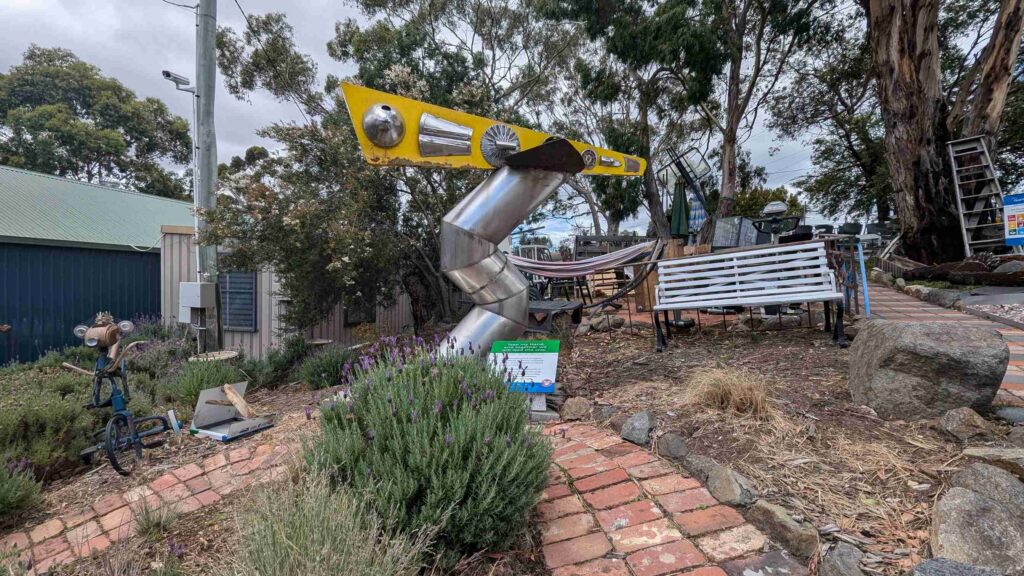
Recovery chose Arts as our medium to communicate & educate 21st century sustainability ideas to the re-use community and to celebrate our 34 years of collective efforts! It our gift to the generations.
And of course, we just love showcasing and promoting Tasmanian makers & designers who contribute to a sustainable future.
We commission a local found object maker, providing an education theme we would like to explore, and the artist does the rest. The piece is added to our education trail and incorporated into our circular economy lecture series.
As the sustainability trail is theme based, you can also partake in a detailed learning experience by accessing the QR codes on selected information panels.
The upgrading of the education trail signage & related assets in 2026, was supported by a grant from the Tasmanian Waste & Resource Recovery Board sponsorship programe, which is funded by the Tasmanian Government
If you are interested in an immersive circular economy education tour, please see the education tab on our website – www.theglenorchytipshop.com.au.
2005 Daniella Maniero
Theme – water & aquatic environments
Piece – Waste Stream Totem
A gift to Recovery from Danielle Maniro in 2005, celebrating fresh water, marine and land-based life.

Scan or click the QR code
2013 John Williamson – Designer & Maker
Theme: Love of Community, Love of Place.
Pieces – Serendipity & Good Consumer Choice Flowers.
John is a found object sculpture maker and Recovery’s first commission. John’s work established the overall style for the collection – his themes were love of community and place.
Serendipity presents ongoing connections between people and place large and small. And how extraordinary things can emerge or rise from nowhere or from PVC pipe!
It’s a reminder that Nature is forever connected, it is not survival of the fittest, its survival of the most connected- in continuous exchanges of resources & processes, which are reliant upon one another. Order at one system level is due to order at a higher system level. Hence another term for the circular economy – the industrial ecology.
Good consumer choice flowers is a transformation of washing machine motors, to flower petals. Hand tools to a vase filled with beauty.
2014 Ben Beames, Metal Manipulation artist
Theme: Plastic Pollution & uselessness
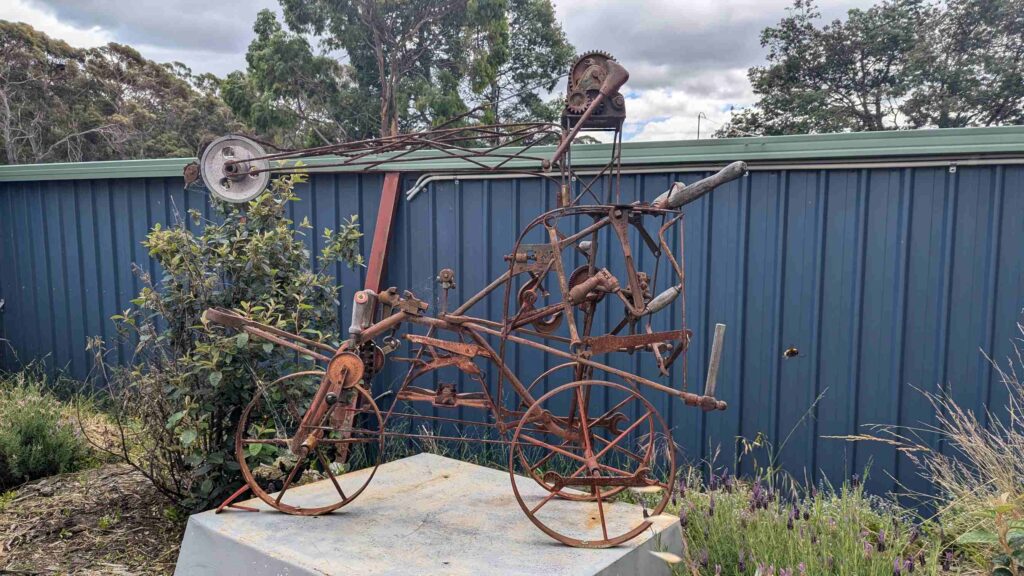
Piece Let’s Talk Plastic
The process of developing this piece determined the theme. Ben initially considered making a sculpture from old washing machines. Taking one home, he stripped it down and found fifteen diverse types of plastic – all of which were useless, upon discussions we decided on ‘Let’s talk plastic.’
Let’s talk plastic is alive! It features common red plastic household items in the seat & globes which are photodegrading – that is turning white, demonstrating what plastic does in the environment, continuously breaking into ever smaller pieces becoming a persistent pollutant.

Scan or click the QR code
Scott Flecther Collection – Metal Artist
Themes: Community engagement & transformation
Pieces: Wanda Waste Not, Want not Wallaby, Waza & Joey, Fletch & his dog Lockwood, the Tip Goddess.
Scott Fletcher – Fletch, works at Recovery Circular Hub. Scott came to the owners one day and said, ‘I’ve been making a few things in my back yard, do you want to have look?’ We did and immediately purchased Fletch & his dog Lockwood.
Fletch has a talent for characters and loves animals, he is maker of Wanda, Wazza & Joey, our waste wise wallabies, and the Tip Goddess as the figure head on the eWaste sales and processing structure.
Steve Palmer Collection
Themes –offering re-use
Pieces Man Holding a Flower & The CE Spiral
Steve Palmer, R.I.P was a first Glenorchy Tip Shopper and exhibitor at Art from Trash. He lived at Cygnet and revelled in reconstructing & reimagining large industrial discards from Hydro, the then Zinc Works & Cadbury’s.
The Moonah Arts Centre and Steve’s son Mick have loaned two pieces to Recovery Tas, after their decommissioning from the Derwent Entertainment Centre
The man holding a flower – is an invitation to share our creativity, and work together to deliver a sustainable safe future.
The Circular Economy spiral, located at the carpark entrance is a celebration of the longevity of well-made, high-quality materials & objects, which have a re-use life beyond industrial applications.
2016 Donna Ritchie – Mosaic artist
Theme: Climate Change & Impact on Islands
Piece: The Tipping Point can become a Turning Point
The tipping point was commissioned in 2015 as global leaders met to create the Paris Agreement to combat climate change by limiting global warming to below 1.5 degrees by 2030. The West was debating sea level rise with small islands in the pacific such as Tuvalu stating they would be under the water at 1.5 degrees warming.
Donna Ritchie, a master of mosaics accepted the commission & worked with the theme of Islands, consumption & climate change.
Initially the piece contained three glass domes with miniature scenes. Ironically, the plastic figures melted under the domes. Donna replaced the Islands and incorporated a new message.
As you walk round the mosaic features rising seas, melting glaciers, storm surges, and all-seeing all-knowing eyes.
It has three islands with the words this is, not yet, our fate, presenting three pathways of extinction, anarchy, or peace – and collectively we decide.

Scan or click the QR code
2019 – Age of Glorious Nonsense, celebrating 25 years of Tipshop trading
Theme – changing social & production values through time related to waste generation.
Brad Mashman Designer & Maker – dioramas.
Scott Fletcher – Durga, Maggie Butler – montage.
Patrick Denell – Temple maker
Glorious Nonsense lays out changing Australian social values over two hundred years in Brad Mashman’s diorama form. Commencing with valuing country, through the Great Depressions years, to the 21st century of mass production, hyper individualism & consumer exploitation, ending with sustainability being the highest and most socially important value. Can you find Doctor Who (scrap metal merchant) or Bliss Cat?
Scott Fletcher – Durga Tasmania style is a nod to new multi-cultural community members to aid social inclusion. Durga as a goddess ends wars and brings light & harmony to the world, which is the transformative power of circular economics.
And Maggies to Kiss a Killer montage is sustainable positive actions on the right and negative non- sustainable actions on the left. A contrast between circular & linear economic outcomes.
Glorious nonsense demonstrates the dynamic nature of societies, where important values & cultural norms can change and be reshaped in any era.
2024 Jim Vaughan, Designer maker Hydro Tas & Recovery TAS.
Theme: United Nations Sustainable Development Goals & Circular Economy
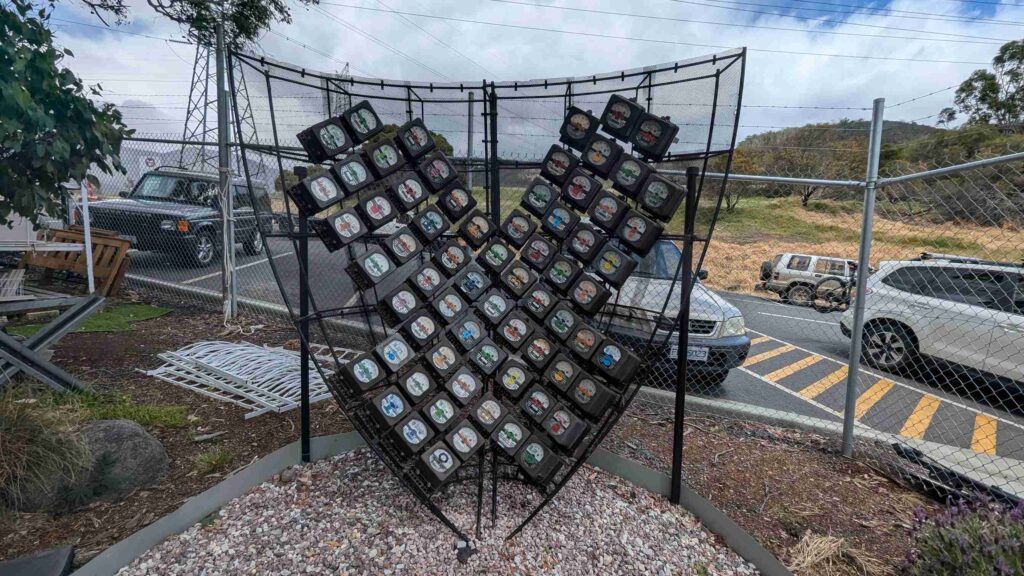
Piece: The Gordon Dam.
The Gordon Dam was made by Tasmanian Jim Vaughan, a designer maker in 1996 for the second Art from Trash exhibition. Purchased by Hydro Tasmania on display at Waddamana Power Station for 25 years.
Hydro working with Recovery reconstructed the entire piece. Comprised of 68 decommissioned meters, each one was scrubbed, washed, repaired, kill rusted and resealed – total of forty-two labour hours.
The meters reimagined by Jon Williamson & Rena Dare display the United Nations Sustainable Development goals and the key principles of the circular economy.
The piece enables informed conversations regarding what UN goals are important to individual visiting students and why.
One of the best conversations, an 11-year-old student from Austins Ferry, who said clean energy was about positive vibes….so true.

Scan or click the QR code
2026 Ella Knight, Designer & Maker
Theme: Natural Capital Budgets
Piece: NACABU Natural Capital Budget dragon
NACABU is made by Tasmanian Ella Knight -a jewellery maker with extraordinary finesse.
NACABU evolved from conversations about the concept of NAtural resources as CApital and the creation of an annual BUdget to keep their use at or below the sustainable level.
Humans use natural resources in many ways. It is not just one industry, it is everything we do, and this is reflected by the many elements which Nacabu is made of.
The trampoline parts which make up the main body represent the children who will bear the consequences of the decisions which are made now.
It’s one gold tooth is a reminder that no matter how good it looks from the outside, gloss on a broken system-is like gold plating on a rotten tooth-is not fixing the problem.
The issues surrounding the care of our planet can be overwhelming and can feel insurmountable; the power of Nacabu is that it holds a way clear in the confusion, inviting you through, and on the path to a positive future.

Scan or click the QR code